+254797 813499

.png)
Posted by Doddy Collince OKelo on 03-Mar-2026
Someone is paying for a crisis they had nothing to do with. Her name is Susan. And she is why every young Kenyan needs to read this.
Susan Nakimoru was 16 years old in 2022. Young, bold with dreams of changing the world, if not literally, at least for her family. From Kajiado County, her father was a pastoralist who had invested and held his savings in his herd of cattle. This banking system was working well and giving him sufficient income to put his kids through school. His trust was in a sky that was slowly losing its potential from the years of pollution, but still, it had not failed Susan’s father.
Well, until it did. The 2020-2022 drought that hit Kajiado was like a vicious beast that had been scorned and was back for revenge. First came the drying out of the pastures, followed by the disappearance of rivers, leaving in their place mud. As if this is not enough loss, one by one the livestock dropped lifeless, then two by two, until he watched the last of his cattle die of hunger and thirst. Just like that, the family lost all the financial safety it had and still had to survive the drought.
The only available safety net for the family became Susan. She was to get married. Her dowry, her future, school, and even freedom of choice became the sacrifice the family chose to make to survive. This decision was not made out of cruelty or because her father did not love her, but rather it was the only solution for the survival of the family. As we all have heard before, ‘desperate times call for desperate actions.’
"I was not ready to get married, but my father insisted."
The above eight words are what she said when asked how she felt about getting married at that tender age. Eight words that show the decision was made for her, yet the consequences were hers to carry. Her future was shrunk and redirected to adapt to a crisis she had nothing to do with, but her family’s survival was at stake.
This is what climate change looks like when you take away the graphs. This is what it feels like when you take away the diplomatic language. It looks like a sixteen-year-old girl in a yellow Maasai shawl who was not ready. And her father insisted.
Now ask yourself: how many Susans are there in Kenya right now?
BAKING AND DROWNING AT THE SAME TIME.
In 2024, Kenya faced a dual climate crisis marked by severe drought in the north and devastating floods in other parts of the country. According to the United Nations Office for the Coordination of Humanitarian Affairs (OCHA), over 500,000 people were displaced during the March–May 2024 floods triggered by enhanced long rains and El Niño conditions, with widespread destruction of homes, schools, roads, and critical infrastructure across dozens of counties. The drought preceding the floods had already been described by the UNICEF as one of the worst in decades, particularly affecting arid and semi-arid regions of northern Kenya. Agricultural losses were significant, with the Kenya Meteorological Department and the International Federation of Red Cross and Red Crescent Societies reporting that thousands of acres of farmland were destroyed by floodwaters. Additionally, the United Nations Population Fund (UNFPA) noted that tens of thousands of pregnant and lactating mothers were cut off from essential maternal health services due to displacement, damaged health facilities, and impassable roads, increasing their vulnerability to life-threatening complications.
One nation, same year, one side dying due to lack of water and the other dying as a result of too much water. Quite the adverse irony from nature if you ask me. Somewhere in the middle of all of these problems were young Kenyans working day and night to build a solid future on thin sand. To be precise, here are the numbers:
· Over 9 million children in Kenya are currently exposed to severe drought and water scarcity, according to the United Nations Children’s Fund (UNICEF) Kenya Climate Landscape Analysis, which identifies children as among the most climate-vulnerable populations in the country.
· More than 2 million learners had their education disrupted by climate disasters in 2024 alone, particularly during the March–May floods, as reported by United Nations Children’s Fund in its global assessment of climate-related school disruptions.
· Kenya is now experiencing an average of 2.8 climate-related disasters per year, up from 0.5 per year in 2000, according to analysis by the African Climate Foundation, reflecting a sharp rise in the frequency of droughts and floods over the past two decades.
· The climate crisis costs Kenya between 2–2.8% of its GDP annually, based on economic assessments by the African Climate Foundation, representing billions of shillings lost each year, resources that could otherwise be invested in schools, hospitals, and long-term development for young Kenyans
Now, the country anticipates drought every 2-3 years as opposed to 10 years. The temperatures have been rising over the years, and reports claim that by 2050, some parts of Kenya could experience up to a 50% drop in crop yields. All of our lives and livelihoods are on the line, and it is up to us to change this trajectory of impending doom. The thing is, these numbers do not hit everyone the same way. Climate change is experienced differently by everyone, but one thing is guaranteed. Those who are hit the hardest are also the least equipped to handle the situation, and the ones with the heaviest burden to carry. It hits women and children the most, just as it landed hardest on Susan.
Those Paying The Most Knew Nothing Of The Bill
Susan, for us, is not just a girl. She is representative of the entire map. If we carefully follow the map, we end up with a clear blueprint of a pattern so consistent, so structural, and so deliberately overlooked that it cannot be called anything other than injustice.
Susan grew up in a household where the women managed the water, catered to livestock, built houses and saw to the daily survival of the household while legally owning almost none of it. Women make up more than 50% of Kenya's agricultural workforce. They own less than 20% of the land. When the drought came and the cattle died, Susan's mother had no legal claim to anything. No land to sell, no asset to leverage, no safety net of her own. The safety net became Susan.
According to community elders in Samburu, the roads to the rivers are where defilements and assaults happen, early in the morning and late in the evening. So, it is not just the early marriages, it is the food Susan's mother ate last, it is the pregnancy that cannot be safely delivered because the clinic is 30 kilometres away, and the road, flooded two weeks ago. It is in all the extra struggle and pain that climate reports do not adequately capture.
In 14 of the 23 Kenyan counties worst affected by drought, girls are already in FGM hotspots. Climate disaster does not create this vulnerability — it accelerates it, violently and fast.
Once the crisis has passed, girls like Susan do not get to hit the reset button and go back to school. Now they are wives and possibly mothers, and their responsibilities and priorities have changed. The boys come back.
Between 2016 and 2019 alone, Kenya recorded over 1,996 official cases of child marriage and 2,105 cases of adolescent pregnancy. These are only the cases that were reported. Researchers who work in drought-affected counties will tell you that the real numbers are far higher.
GBV cases in drought-hit counties rose 50% between 2021 and 2022. The climate crisis is not separate from the violence women face. It is one of its engines.
Meanwhile, nearly 80% of Kenya's tracked climate finance goes to mitigation, and only 11.7% goes to adaptation — to the water systems, community resilience, and social protection programmes that would have kept Susan's family stable enough that her future was never on the table.
We have built the architecture to trade carbon credits. We have not built the architecture to keep girls in school when the rains fail. That is a choice. And choices can be changed — but only when enough people name them, loudly, together.
Here Is What They Have Forgotten To Write In The Reports
In communities across Kajiado, women's groups are training in diversified livelihoods, finding ways to reduce the dependence on cattle that makes daughters vulnerable when droughts come. In Turkana, youth-led initiatives are pioneering rainwater harvesting that is keeping communities alive through consecutive dry seasons. In Garissa and Marsabit, organisations like Womankind Kenya are running grassroots climate forums — not for women, but with women, designed by women who understand the specific geography of their own survival. The Kenya Youth Climate Action Network is carrying youth voices into policy spaces. At the 2025 National Youth Climate Action Summit, over 200 young Kenyans produced a declaration that was handed directly to the government.
The knowledge is with us, and so is the energy. The future is being built, slowly but surely, by the same people our systems have been failing. What is missing is not ideas. What is missing is a single, unified, impossible-to-ignore voice that carries all of this into the rooms where decisions are made.
That is what this manifesto is. That is why it needs to carry Susan's story, and yours, and every voice this country has been too comfortable leaving out.
This Manifesto Is Not Just A Document. It Is The Reckoning.
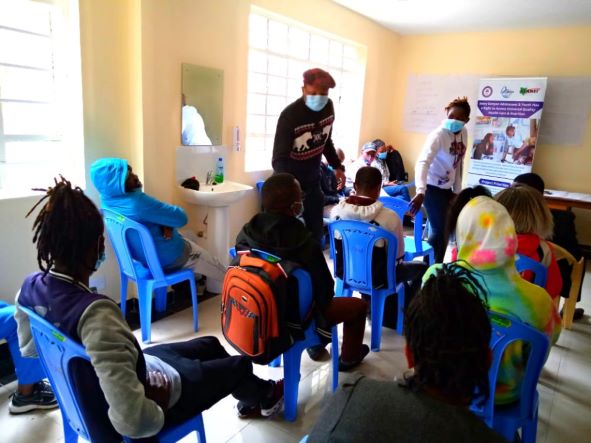
We have already begun. Young people have come together for training and discussion forums, and the conversations have been real and raw. The kind of conversations that do not end when the forum closes, they follow you home and sit with you at dinner and haunt you to do something.
We have talked about the droughts and the floods, about the climate finance that never reaches the communities that need it, about policies that are drafted without us, for us. About Susan's story, and the thousand variations of it playing out in 47 counties, right now, as you read this.
And now comes the most important part. The part that is still being written — by you.
Your story is not anecdote. It is evidence. Your Voice is one that can change the world, and this manifesto will not be complete without it.
We are not coming to you with a finished document to collect signatures. We are coming to you at the beginning. In the messy, most essential part of the process, where the most important decisions are made. At the point where we get to decide what this manifesto demands, whom it demands change or support from, and whose name it carries into the rooms where power sits.
We need the voice of the young woman in Marsabit whose family's livelihood has collapsed because the long rains no longer come when they should. The girl in Kajiado who fought her way back to class and knows exactly what it cost. The young man in Mombasa, watching the ocean claim the shore where he grew up. The student in Kisii. balancing failing food systems with exam pressure after a failed harvest. The woman farmer in Baringo who knows her soil better than any satellite ever will, if anyone would just ask. We need all youth voices, from every corner of the country, to speak up. We are listening.
REMEMBER IF YOUR NAME IS NOT AT THE TABLE, IT IS PROBABLY IN THE MENU.
This Is Your Invitation
The table is being built right now. Not by distant experts. By us, and we are building it wide enough to hold everyone, especially everyone this country has a habit of leaving out.
SHOW UP. Come to the forums, the workshops, the community conversations happening across counties and online. Bring your community. Bring the women in your life who have been surviving and adapting through every crisis but would never call themselves climate activists — because they are the activists. They have always been.
TELL YOUR STORY. Not in statistics. In moments. In the specific weight of a specific loss. If your reality has never appeared in a policy paper, that is not because your reality is too small. It is because the wrong people have been writing the papers. We are trying to fix that.
SHARE THIS. Post it. Send it. Read it aloud at your chama, your campus, your church, your WhatsApp group. The wider this reaches, the harder it becomes to ignore. Every share is a vote for a manifesto that actually represents this country.
DEMAND BETTER. When you contribute to this manifesto, push for it to name the gendered face of climate harm. Demand that adaptation funding reaches the communities absorbing the damage. Demand that women design the solutions, not just survive them. Demand that girls like Susan are never again the price a family pays for a crisis they did not cause.
One Last Thing Our Fellow Youth.
Susan Nakimoru is not a symbol. She is not a case study. She is a sixteen-year-old girl in Kajiado who wanted to finish school, and whose chance to do so was taken by a drought that had nothing to do with anything she or her father or her community ever did.
There are things we cannot give back to her. The time. The classroom. The particular shape of the future she had imagined. However, there are things we can still do. We can build a manifesto that speaks her truth into the rooms where policy is made. We can demand climate finance that actually reaches communities like hers. We can insist that the next girl in Kajiado, the one who is twelve right now, who is in school right now, who has not yet faced what Susan faced, has a system that gives her a solid foundation to build her future on.
Kenya's constitution guarantees every citizen the right to a clean and healthy environment, but a right without a voice behind it is just ink on a piece of paper. We are the voice that the ink needs to be resurrected and give us the Kenya we envision.
We did not cause this crisis. But we are the ones who will decide whether this country rises to meet it — or looks away while the most vulnerable among us keep paying.
Do not look away.
Write this manifesto with us.
Sources
The Fuller Project: From Drought to Floods — Climate Crisis After Crisis Keeps Women on Edge in East Africa (2024) • The Fuller Project: How Climate Change is Hitting Kenyan Girls' Education (2024) • Alternatives Humanitaires / Alessio Paduano: Climate Change in Kenya — Drought and Water Insecurity (2025) • Talk Africa: The COP30 Betrayal — How Kenya's Gender-Blind Climate Policy is Costing Girls Their Future (2025) • UNICEF USA: Climate Crisis in Kenya — A Journey Toward Resilience and Learning (2024) • Dialogue Earth: Life After Kenya's Floods of 2024 (2025) • BMJ Global Health: How Climate Change Amplifies Sexual and Reproductive Health Risks for Young Adolescents in Kenya (2025) • ODI Humanitarian Practice Network: Women and Climate Change in Northern Kenya (2025) • UN Women Gender Snapshot 2024 • Organization of African Youth — National Youth Climate Action Summit Report (2025) • African Climate Foundation / World Bank: From Climate Risk to Resilience (2023) • Girls Not Brides Kenya Profile (2024) • Kenya Red Cross Turkana Water Access Analysis
© 2026 Organisation Of African Youth | All Right Reserved.
Powered By Elvan Technologies

.jpg)
-fotor-2026072113348.png)

0 Comments